
In Odds We Trust
A gambling president and a gambling nation bet on the future

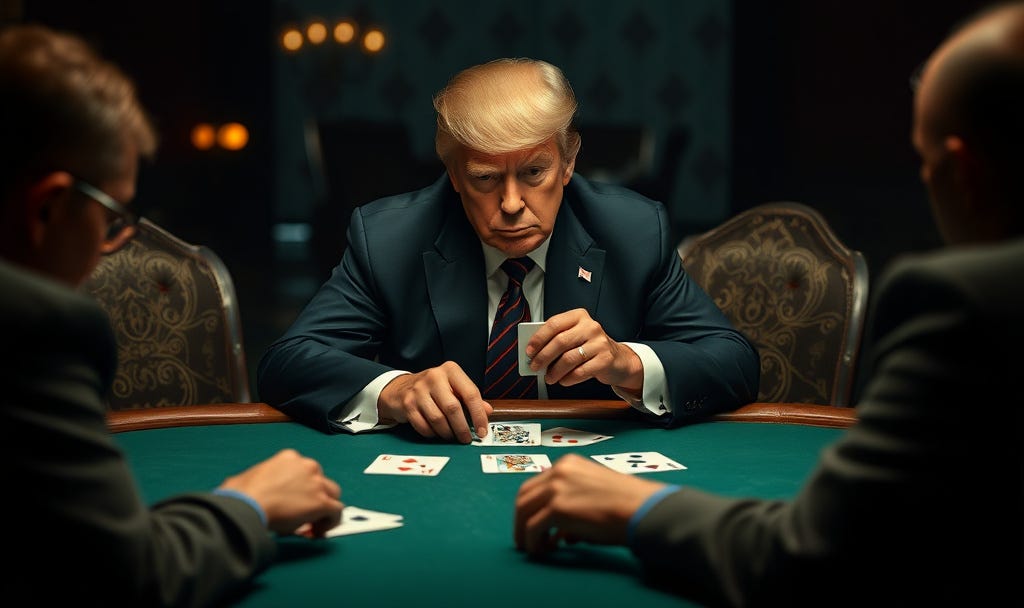
Why does Donald Trump’s White House operate like a casino in Las Vegas on a Friday night; with punters who open big, talk loudly, and see who flinches first?
Because the U.S President is a poker player.
And once you understand that, American politics start to make a lot more sense.
Poker isn’t about perfect strategy. It’s about nerve, pressure and convincing others you’re willing to go all in. Poker is about anchoring the table with a large bet and seeing who folds.
And right now, America has a President who’s very comfortable pushing his chips into the middle.
The President’s critics mock him and say he’s not playing “5-D chess.” The last laugh is on them because Trump has no intention of playing chess. He’s a gambler.
Every president takes risks - and they should, because power is about managing risk. But even those in his cabinet are struck by the scale of Trump’s fearlessness.
Treasury Secretary Scott Bessent, a respected veteran of global markets, has remarked that Trump’s tolerance for risk exceeds his own. And Bessent is not a man unfamiliar with bold trades; he worked at Soros Fund Management during its era of aggressive currency betting, when billion-dollar positions could move nations.
So if someone forged in that world describes Trump’s appetite as “maximalist,” it tells you something about the size of the table.
We know the drill.
Tariffs, ultimatums, shock withdrawals, brinkmanship demands.
Poker Presidency
In poker there’s something called “range compression.” You make such an aggressive anchoring move that everyone else is forced to respond within the limits you’ve set. Even if you later “concede,” the game has been played on your terms.
It’s a misrepresentation to say that Trump ‘always chickens out.’ Not so. Trump’s modus operandi is not to necessarily hold the perfect hand or know the endgame. The goal is to control the tempo and make everyone else react to you.
Here’s the interesting question.
Why does this resonate with voters across the U.S.A?
Because Americans increasingly think in bets too.
Gambling Nation
The United States has always had a speculative streak. The Revolution was a gamble. Westward expansion was a roll of the dice. Silicon Valley was built on venture bets that mostly failed before one paid off big enough to fund the next five start-ups and a meditation app.
Risk is baked into the national character.
What has changed is how casual it feels.
The Super Bowl now draws well over 120 million viewers. It is also the single largest legal betting day in America. More than $1.7 billion was wagered on the game between the Seattle Seahawks and the New England Patriots. Bets were placed on touchdowns, yes, but also the coin toss, the length of the national anthem and the color of the Gatorade.
Online sports betting is now so mainstream that my daughter’s high school recently brought in a speaker to warn the teenagers about gambling addiction. Speculation is no longer marginal, it’s recreational.
And it doesn’t stop at sports. Life has become gamified.

4% Chance of the Second Coming in 2026
Platforms like Polymarket and Kalshi let Americans put money behind their expectations of the future.
Gambling on prediction markets is like playing a drinking game for current events (and conspiracy theories) but the shots cost real money.
There’s an explosion in betting on everything, and anything.
Will Jeffrey Epstein confirmed to be alive before 2027 Yes or No? 6 % chance.
Will Jesus Christ return before 2027 Yes or No? 4% chance.
With the rise of prediction markets, gambling on the news has become participatory. Polymarket and Kalshi are turning audiences, readers, and viewers into stakeholders. The risks are high. Insider knowledge has never been easy to commoditize.
But still, people put down money. In America right now, belief is no longer argued - it’s priced.
I find it fascinating that, in a fragmented world, betting feels more honest than reading The New York Times.
Why hedging feels rational
For decades Americans were told to trust polls, intelligence agencies, the White House, public health authorities, legacy media.
Then came moments that chipped away at trust in the gatekeepers.
Polling errors in key elections. Conflicting COVID messaging. The foreign interventions were sold with a confidence that history later treated harshly. Newsrooms appeared to sort themselves ideologically, not journalistically.
Not every institution failed, but enough high-profile misjudgments accumulated that confidence fractured.
I wonder if the rise of prediction markets - and Donald Trump - is because they feel less preachy?
When the table plays back
Aggressive opening gambits work best when others are risk-averse. A player who keeps raising the stakes only gains leverage if opponents fear losing more than he does. The moment the table adjusts the edge narrows.
The same logic applies geopolitically to the second Trump term. Could allies stop panicking at opening threats? Are markets pricing in disruption as routine rather than shocking? Will adversaries, like China, delay instead of react?
Chaos only works as leverage when it feels rare. When it’s coming from the White House every minute of every day, how expensive does it become? How sustainable is the gambler’s instinct when the table learns to read their game?
All-in, America?
A gambling president did not invent America’s all-in culture, he revealed it. Americans voted for him because they recognized themselves in him. Do they still?
Trump has always had an instinct for cultural undercurrents. His tolerance for turbulence mirrors a broader shift toward probabilistic thinking and comfort with risk. And in a country that prices belief in probabilities, betting against a gambler can be an expensive mistake.
So when outsiders ask me if the Republicans are going to lose badly at the midterms, I’m hesitant to write off the right.
Because both the president and many Americans think in wagers.
In an odds era, you don’t count the gambler out. You wait to see who calls his hand.
LISTEN TO THIS EPISODE ON ROBYN’S SEARCHING FOR AMERICA PODCAST ON APPLE AND SPOTIFY
Seems like the White House overplayed its hand in Greenland and Minneapolis. Will be interesting to see how they manage their chips over the next 20 or so months.